
Fly Agaric Symbolism: Where the Name Comes From and Why It Means Good Luck
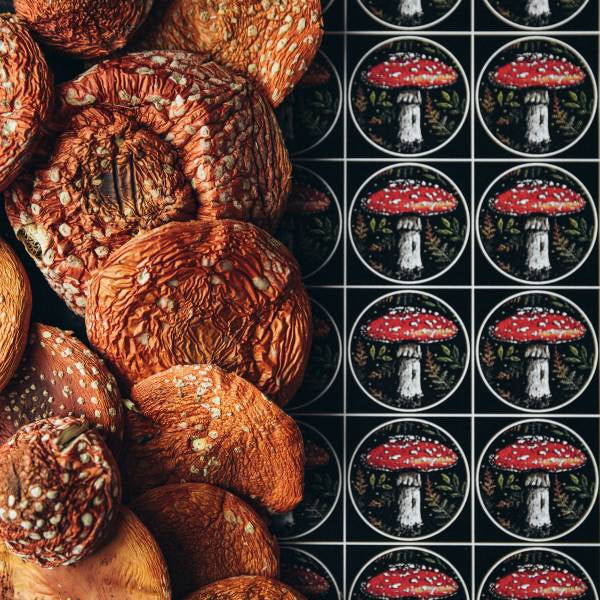
The fly agaric (Amanita muscaria) is probably the most recognisable mushroom in the world. The red cap with white spots appears in children's books, on greeting cards, on Christmas trees and in logos. How did it become a symbol of good luck?
Where the name "fly agaric" comes from
The name comes from an old household use. Pieces of the mushroom were put in sweetened milk, flies were drawn to it and died. Hence "mukhomor" in Ukrainian, "Fliegenpilz" in German and "fly agaric" in English. Similar names exist in many other languages.
A good-luck symbol in Germany and Austria
In German-speaking countries the fly agaric sits alongside the horseshoe, the four-leaf clover, the chimney sweep and the lucky pig. For New Year's Eve (Silvester) people give each other small fly agaric figures, marzipan mushrooms and cards with the red mushroom.
Interestingly, the German word "Glückspilz" (lucky person, literally "luck mushroom") was at first rather negative. It described upstarts who suddenly "shot up like mushrooms". The positive meaning "someone who is lucky" only took hold in the second half of the 19th century.
The fly agaric in fairy tales and at Christmas
In European fairy tales, gnomes and elves live under the fly agaric, and 19th-century illustrations often show it next to them. Glass fly agarics hang on Christmas trees, and the red and white colours suit festive decorations.
There is also a theory that the image of Santa Claus in red and white goes back to the fly agaric and Siberian shamans. Experts consider it unproven: there is no direct historical evidence.
The fly agaric in northern cultures
In Siberia the fly agaric had ritual significance for shamans for centuries. Many modern myths about the mushroom trace back to these traditions. The popular story that Scandinavian berserkers used fly agarics to work themselves into a battle frenzy, however, has no reliable evidence behind it.
Why red?
The simplest explanation for its popularity is the colour. The bright red cap with white spots stands out from a distance, is easy to draw and sticks in the memory. The ladybird became a lucky charm for the same reason: red colour and spots.

For all its fairy-tale charm, the fly agaric remains a poisonous mushroom. It contains ibotenic acid and muscimol, which act on the nervous system. Admire it in the woods, on cards and on the Christmas tree.
How to tell the fly agaric from the panther cap is explained in our article "Fly Agaric vs Panther Cap: How to Tell Them Apart".
About Muhomornya
Muhomornya is an online shop for dried mushrooms.