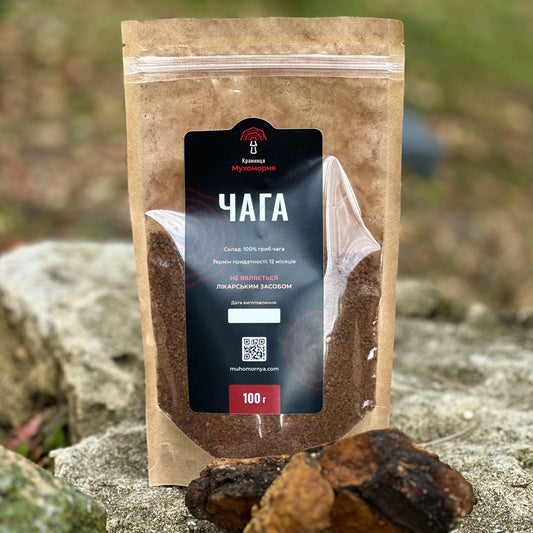
We sell chaga (Inonotus obliquus) in one form: as a finely ground powder. It brews quickly and is easy to measure out for tea.
What is chaga mushroom?
Chaga looks nothing like an ordinary mushroom: it has no cap and no stem. It's a hard growth on the trunk of a living birch that draws nutrients from the tree for years. From the side it looks like a lump of charred bark, and plenty of people walk straight past it in the forest without realising it's a fungus.
You can tell real chaga by breaking it. The outside is black and cracked like charcoal, and the inside is a rusty orange-brown. That contrast is what sets it apart from ordinary growths on trees.
Why the birch matters
What's in chaga depends on the tree it grew on. Betulin, the compound that makes birch bark white, comes into chaga from the birch itself. A growth on a different tree has a different make-up, and chaga grown on grain or another artificial substrate contains almost no betulin. We don't sell that kind.
Where we harvest chaga
Our chaga grows in the birch forests of the Carpathians. The growth is never cut right down to the bark, so part of it stays on the tree and grows back over the years. We dry the harvested pieces and then grind them into a fine powder.
How to brew chaga powder
Chaga is as dense as wood, so chunks need a long, slow simmer. Powder is simpler: pour hot water over it, cover and leave it for 10–15 minutes. The taste is mild and earthy, with a light hint of vanilla and no bitterness. Some people stir the powder into coffee or cocoa.
What the research says
Scientists have studied chaga for a long time, mostly in two directions.
- Antioxidants: in lab tests, chaga extracts show high antioxidant activity, which is where its reputation as one of the richest natural sources of antioxidants comes from.
- Polysaccharides and betulinic acid, which are being studied in connection with the immune system.
Almost all of this research has so far been done on cells in a test tube or on animals. There are few large studies in humans, so it's too early to talk about any specific effect of chaga on the body. We sell chaga as a product for brewing, not as a treatment or a way to prevent illness.
Warnings
Chaga is high in oxalates. People with kidney stones or kidney disease are better off not drinking it: there are documented cases of kidney damage in people who drank strong chaga every day for a long time. If you drink chaga, take breaks and don't brew it too strong.
Chaga may lower blood sugar and affect blood clotting. If you take diabetes medication, blood thinners or immunosuppressants, talk to your doctor first. We don't recommend chaga during pregnancy or breastfeeding.
You can buy chaga mushroom powder at Muhomornya, with delivery across Ukraine and abroad.