
How to determine the quality of amanita mushrooms
As we've already covered, red fly agaric is a mushroom with notable properties that has long drawn interest in the world of natural mushroom products. Today we'll talk about how to judge the quality of the mushroom, both while foraging it yourself and when buying ready-made dried products.
Foraging Fly Agaric in the Forest
The quality of fly agaric mushrooms depends on where they grow, the collection season, and the weather. If you're planning to forage fly agaric, keep the following in mind: the best time is the middle of the season. The ideal location is birch forest, not oak or pine. Mushrooms intended for microdosing should be collected from the second half of July through October. Choose mushrooms with caps 8–10 cm in diameter that haven't fully opened yet and show no damage. Mushrooms with large caps are already old, and the quality of that material is worse, so we recommend skipping them. The more white flecks on the cap, the better. Pay attention to whether there's a "skirt" on the upper part of the stem; its presence signals a higher-quality mushroom. Avoid foraging near fields (which may have been treated with pesticides) or roadsides. Collect the mushrooms in a basket or bucket so they don't get crushed, and remember to clear leaves, dry grass, and similar debris off the caps. The mushroom should feel firm and clean, not dried out. Don't forage right after rain, give it 2–3 hours to dry first. Following these guidelines helps the mushroom retain its natural properties as well as possible.

Don't put off drying. Fly agaric spoils quickly, so get it into a dehydrator promptly and prepare it for storage. Depending on quality, mushrooms are sorted into top, first, and second grade. Top-grade caps are sold on their own, while first-grade caps are ground into powder or used to fill capsules.
Judging the Quality of Purchased Dried Caps
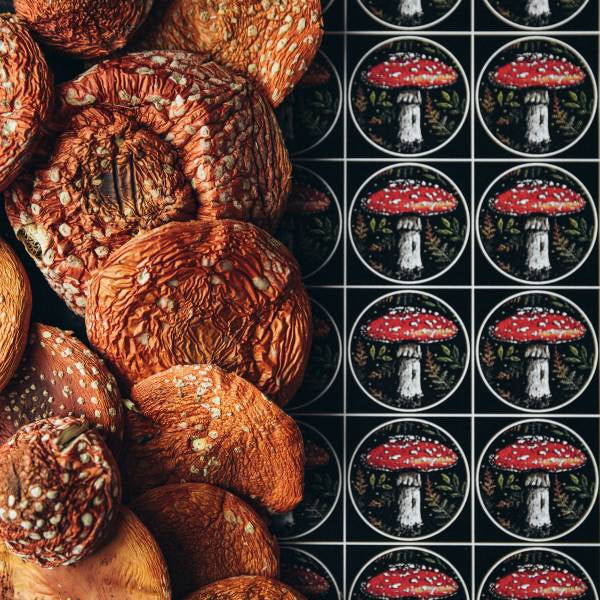
Properly dried fly agaric caps have a uniform color and break rather than bend. If they bend instead, something went wrong during processing. The aroma matters too: correctly dried caps don't smell damp, they smell more like antibiotics (sometimes described as a "pharmacy" smell) or carry a mild, sweet scent. Caps weigh around 2 grams on average. Buy dried fly agaric for microdosing at an affordable price.
Judging the Quality of Red Fly Agaric Powder
Powder made correctly from good-quality fly agaric has a light consistency and a rich yellow color, it shouldn't look pale. Fine grinding is a sign of a well-made product. It shouldn't carry any sharp smell, especially not mold. How strong the powder's flavor is depends partly on how long ago it was dried: the further back that was, the weaker this characteristic tends to be.
Judging the Quality of Fly Agaric Capsules for Microdosing
Capsules filled with ground fly agaric usually show a shade close to orange, unless the capsule shell itself contains a dye. To check the quality of what's inside, cut or open a capsule and empty out the contents: the finer the texture, the better the product. Ideally, the powder looks like flour. It's also worth checking that the contents don't smell damp or carry any sharp odor.
Buy fly agaric in capsules for microdosing.
Fly agaric that's been foraged incorrectly, processed poorly, or filled into capsules at the wrong concentration won't give you the experience you're looking for. It's also a waste of money. So it's worth being deliberate about where your red fly agaric products come from.